Tuesday, August 30, 2011
Reflection Term 3 Science Test
This term, I took a science test. Honestly speaking, I am not really happy with my results of 31.5 as I feel that I could have scored higher. This is because I misinterpreted one of the 4 marks question in the paper where I am suppose to describe the trend given but instead, I gave reasons for the trend. Also, I feel that I got this score because I did not revise enough on the topic optics and when I was asked to draw the light rays on the diagram, I drew them wrongly and lost another two marks. In addition, I had a few careless mistakes here and there and thus, got this undesired marks. From the test, I really learnt a lot. Firstly, I learnt that it is very important to read the questions very carefully before answering the question for all the subjects so that unnecessary marks would not be lost. Also, I learnt that it is very important to understand the subjects or topics tested well before going for the test, so that there would not be questions which are surprise to me when I get the test paper as questions can come in many different forms and the most important thing is to understand the concept well and not understand the question we do for practice well. Lastly, I learnt that I should treat every test seriously and check through the paper after completing it so as to minimise careless mistakes as these marks are really wasted if they are lost to careless mistakes. This test serves as a final reminder to me to work hard, and be more careful when doing my end-of-year paper. I will definitely treat this seriously and not repeat these mistakes!

Sunday, June 26, 2011
Reflection on issues faced in science
Firstly, I feel that our science lesson is not used to its fullest as Ms.Lim seemed to be able to control only the first half of the class and not the other half sitting at the back who would waste time asking the same questions again and again, wasting precious time, causing the whole class to slow down as a whole, not able to complete the syllabus for the term. I feel that it is the class that is losing out and at the very end, it is our grades which are affected. I think that the teacher could have been stricter with the class and at the same time organise more remedial classes if the syllabus could not be completed, however, not forgetting that not everyone is free on a particular day, therefore, I feel that the teacher should have like two days a week for remedial where the same things are taught so that those who cannot attend the first day can go for the second day or even find out from their friends what they have missed out. Hopefully, from this, we would be able to improve out grades as a whole and live up to our own expections as I noticed that some of us really want to learn but got distracted by the rowdiness of the class. Also, those who are not interested in the remedial can have the will to not go for it so that those who really want to learn would be able to absorb 100% of what the teacher wants to teach.
Experiment on properties of light
This experiment is to prove that light reflected from the mirror is laterally inverted.
Materials:
Pencil
Mirror
Paper
Steps/Procedures:
Firstly, write your name on the paper or draw on the paper. Next, place the mirror upright behind the paper so that you can see the drawing reflected on the mirror. Then, try to trace over the things written on the paper whilst keeping your eyes on the image of the mirror at all times.
Result:
You will find it extremely difficult to trace the things on the paper as the image seen on the mirror is laterally inverted.
Reflections:
I chose to do this simple experiment as kids like us always like to us why does this particular topic or things have these properties. As I am learning light this term, I thought it would be good to prove one of the properties of light: image formed in the mirror is laterally inverted. This experiment is simple but meets its purpose. I hope that this experiment would inspire teachers to do my experiments to prove properties of a particular topic they are teaching so that we students would be able to learn and absorb things faster.
Materials:
Pencil
Mirror
Paper
Steps/Procedures:
Firstly, write your name on the paper or draw on the paper. Next, place the mirror upright behind the paper so that you can see the drawing reflected on the mirror. Then, try to trace over the things written on the paper whilst keeping your eyes on the image of the mirror at all times.
Result:
You will find it extremely difficult to trace the things on the paper as the image seen on the mirror is laterally inverted.
Reflections:
I chose to do this simple experiment as kids like us always like to us why does this particular topic or things have these properties. As I am learning light this term, I thought it would be good to prove one of the properties of light: image formed in the mirror is laterally inverted. This experiment is simple but meets its purpose. I hope that this experiment would inspire teachers to do my experiments to prove properties of a particular topic they are teaching so that we students would be able to learn and absorb things faster.
An experiment on Refraction
Definition: Refraction is the change in direction of a wave due to a change in its speed.
Materials needed:
Coin
Bowl
Water
Steps/Procedure:
First, put the bowl on a table and place the coin into the bowl. Make sure the coin is at the bottom of the bowl. Next, keep looking at the coin while moving backwards slowly until the coin is out of sight. Stand at the same position and get a person to pour water into the bowl.
Result:
One can see the coin at that position now (after adding water).
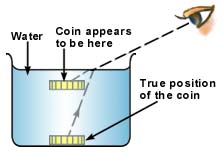
Explanation: As the water is poured into the bowl, the light is refracted. This made the image of the coin "move up" which enable our eyes to see the coin again, however, this image is virtual as it is not the actually coin we are seeing.
Picture of the diagram:

Reflections:
I chose to do this experiment as firstly, I am learning the topic of light and this is one of the components of it. This experiment is one of the many which show refraction of light but I feel that one would be able to understand the "secret" behind refraction of light best through this simple experiments. I have also seen question on this experiment coming out in my practice papers, thus I was inspired to do this experiment. After doing this experiment, I indeed understand this topic better.
Image from:http://www.wisedude.com/science_engineering/refraction_light.htm
Materials needed:
Coin
Bowl
Water
Steps/Procedure:
First, put the bowl on a table and place the coin into the bowl. Make sure the coin is at the bottom of the bowl. Next, keep looking at the coin while moving backwards slowly until the coin is out of sight. Stand at the same position and get a person to pour water into the bowl.
Result:
One can see the coin at that position now (after adding water).
Explanation: As the water is poured into the bowl, the light is refracted. This made the image of the coin "move up" which enable our eyes to see the coin again, however, this image is virtual as it is not the actually coin we are seeing.
Picture of the diagram:
Reflections:
I chose to do this experiment as firstly, I am learning the topic of light and this is one of the components of it. This experiment is one of the many which show refraction of light but I feel that one would be able to understand the "secret" behind refraction of light best through this simple experiments. I have also seen question on this experiment coming out in my practice papers, thus I was inspired to do this experiment. After doing this experiment, I indeed understand this topic better.
Image from:http://www.wisedude.com/science_engineering/refraction_light.htm
Reflection of Term 2 Science Test
Firstly, I am not happy with my science test results this term. Although I got an A1 for science this term, it is a borderline one and my class ranking for science has also dropped by a lot. I think this may be because I did not really understand the topic Light very well which led to the results not really very satisfying. However, I feel that I have already done my best and it is definitely not last minute preparation this time as I prepared two weeks before the test, meeting my science teacher Ms. Lim at least twice a week during this period of time. Till now, I have not really understood where I have gone wrong as my teacher have not gone through the test. However, I feel that I would be able to do better in the next test and I also learnt that it does not really matters when we prepare for the test, but how much we understand the topics tested.
Tuesday, March 29, 2011
Newton's First Law of motion- law of inertia
Definition: An object stays in the same form (at rest or moving) in the same speed and direction unless acted upon by a unbalanced force.
Have you ever wondered why your body moves forward when a bus brakes and why your body tends to lean back when the bus speeds up? This is because be it an object or a living thing, we tend to "keep on doing what we are doing", which means that we tend to want to stay in the position we are in. The force of the road on the locked wheels provides the unbalanced force to change the car's state of motion, however we have no unbalanced force to change our state of motion. Thus, when the car breaks, we continue in motion, making us lean forward. In this case, seat belt is invented which would provide the unbalanced force to bring us to a state of rest from a state of motion. However, what is unbalanced forces which was used throughout the explaination?
Unbalanced forces are two forces of equal magnitude and are in opposite directions balancing each other. An example is when a book is resting on a table. The two forces involved are the table which pushes the book upwards and the gravity pull which pulls the book downwards. The book is said to be at equilibrium. There is no unbalanced forces acting on the book, enabling it to maintain its state of motion (when all the forces acting on the book are balanced, there is no unbalanced force and thus the book maintains its state of motion).
However, if a person pushes the book and made it accelerate forward, the object is said to be acted upon as there is no other force with equal magnitude and in the opposite direction to balance the unbalanced force.
Reflections: I feel that this topic which have not been taught yet, is quite easy to understand and also very interesting. I chose this topic because I am very puzzled by the fact that when a bus accelerates, my body moves backwards instead of moving forward and vice versa. As I was searching on the internet for the answer, I found this interesting topic- law of inertia. I decided to research more on it and finally found the answer to it. I will continue to research on topics which are linked to our lives as I find them very captivating and I hope you will look forward to my next post!
Sources: http://www.physicsclassroom.com/class/newtlaws/u2l1d.cfm#balanced
http://www.physicsclassroom.com/class/newtlaws/u2l1a.cfm
Have you ever wondered why your body moves forward when a bus brakes and why your body tends to lean back when the bus speeds up? This is because be it an object or a living thing, we tend to "keep on doing what we are doing", which means that we tend to want to stay in the position we are in. The force of the road on the locked wheels provides the unbalanced force to change the car's state of motion, however we have no unbalanced force to change our state of motion. Thus, when the car breaks, we continue in motion, making us lean forward. In this case, seat belt is invented which would provide the unbalanced force to bring us to a state of rest from a state of motion. However, what is unbalanced forces which was used throughout the explaination?
Unbalanced forces are two forces of equal magnitude and are in opposite directions balancing each other. An example is when a book is resting on a table. The two forces involved are the table which pushes the book upwards and the gravity pull which pulls the book downwards. The book is said to be at equilibrium. There is no unbalanced forces acting on the book, enabling it to maintain its state of motion (when all the forces acting on the book are balanced, there is no unbalanced force and thus the book maintains its state of motion).
However, if a person pushes the book and made it accelerate forward, the object is said to be acted upon as there is no other force with equal magnitude and in the opposite direction to balance the unbalanced force.
Reflections: I feel that this topic which have not been taught yet, is quite easy to understand and also very interesting. I chose this topic because I am very puzzled by the fact that when a bus accelerates, my body moves backwards instead of moving forward and vice versa. As I was searching on the internet for the answer, I found this interesting topic- law of inertia. I decided to research more on it and finally found the answer to it. I will continue to research on topics which are linked to our lives as I find them very captivating and I hope you will look forward to my next post!
Sources: http://www.physicsclassroom.com/class/newtlaws/u2l1d.cfm#balanced
http://www.physicsclassroom.com/class/newtlaws/u2l1a.cfm
Saturday, March 12, 2011
Term 1 Test 1 Reflections
Firstly, I am not very happy with my science results although I got 36/40. This was because I could have gotten first in class with a score of 39/40. There is 3 questions from the MCQ which I knew how to do but was careless. Nevertheless, I have already understood the whole test. This was what I feel is most important in learning-understanding and learning from your mistake. I would not make the same mistakes again after understanding them and I am quite confident in scoring full marks if I were to encounter the questions again.
Next, I would like to talk a little bit on my study method. I feel that this study method of now should be changed as it is just last minute revision by writing down all the notes on the textbook, powerpoint slides and worksheets. This gives me an opportunity to read through them thrice before them. 3 days before the test, I did not really understood the topic and could not even differentiate proton number with mass number etc. However, this method of mine is not bad if I were to start preparing before the test. I would not repeat this mistake again and look forward to the next test.
Next, I would like to talk a little bit on my study method. I feel that this study method of now should be changed as it is just last minute revision by writing down all the notes on the textbook, powerpoint slides and worksheets. This gives me an opportunity to read through them thrice before them. 3 days before the test, I did not really understood the topic and could not even differentiate proton number with mass number etc. However, this method of mine is not bad if I were to start preparing before the test. I would not repeat this mistake again and look forward to the next test.
Saturday, March 5, 2011
Sneezing Myths and Facts
Why do we sneeze?
Ans: The medical term for sneezing is “sternutatory reflex”. Sneezing places a lot of stress on the body and air pressure is also place on the eyes. Sneezing is stimulated by a tickle in the nose. It helps us to clear germs and bacteria in our nose, at the same time, take in oxygen. Sneezing is something we have no control over.
Myths and Facts of Sneezing
People believe that sneezing has so much pressure that it pops your eyes out and may be deadly while others think that it is just a reflex and some people can even sneeze with their eyes open. Others think that we close our eyes when we sneeze because our body wants to protect our eyes from the germs and bacteria released from our nose by the powerful sneeze.
So... which belief is true?
The website http://library.thinkquest.org/J0112390/sneezing.htm feels that sneezing is a reflex and so is our eyes and that we have no control on whether we can close our eyes or not when we sneeze.
It feels that people who do not have reflex can sneeze with their eyes open while others try to close their eyes to prevent their eyes from popping out.
It also feels that "Your eyes don't really pop out" when we sneeze.
This website disagrees with the fact that people close their eyes to prevent the germs and bacteria which is released from the nose after sneeze from affecting the eyes. It feels that our eyes is constantly in contact with germs and bacteria all the time.
The website http://www.answerbag.com/q_view/22468 has comments of many internet users.
One strong quote from this website is "It is unclear, but scientists theorize that we close our eyes to protect them. We may be protecting our eyes from microorganisms and particles from our sneezes," said Dr. Bonnie Henderson, director of comprehensive ophthalmology at the Massachusetts Eye and Ear Infirmary.
Others feel that it is a natural human instinct to prevent our eyes from popping out.
Another user feels that the air pressure our eyes experience is not strong enough to pop our eyes out.
In contrast, a different user states the evidence of Adolf Hitler making use of sneezing as a torture tactic by forcing his prisoners' eyes to open with toothpicks and sprinkling pepper under their noses to make them sneeze. This made their eyes partially pop out.
Many different people have many views and evidence for the fact of closing our eyes when we sneeze. However, which do you think is true? A warning to readers: Please do not try sneezing with your eyes open as it may really just pop your eyes out.
Reflection/Feelings:
I feel that sneezing would really pop our eyes out as it is strongly supported by the torture tactic Adolf Hitler used on his prisoners. As this is most probably recorded in history, it is more truthful and reliable. Like what my primary school science teacher said, sneezing is a kind of reflex which is so strong that it may pop your eyes out. I did not believe her initially but believed her after researching. Although there are other views on the facts about sneezing, I feel that the most convincing one would be that if you open your eyes when sneezing, your eyes would pop out. It is actually up to individual's beliefs and no one really knows the fact behind it. Nevertheless, sneezing would definitely benefits our body.
Source:http://www.answerbag.com/q_view/22468
http://library.thinkquest.org/J0112390/sneezing.htm
Ans: The medical term for sneezing is “sternutatory reflex”. Sneezing places a lot of stress on the body and air pressure is also place on the eyes. Sneezing is stimulated by a tickle in the nose. It helps us to clear germs and bacteria in our nose, at the same time, take in oxygen. Sneezing is something we have no control over.
Myths and Facts of Sneezing
People believe that sneezing has so much pressure that it pops your eyes out and may be deadly while others think that it is just a reflex and some people can even sneeze with their eyes open. Others think that we close our eyes when we sneeze because our body wants to protect our eyes from the germs and bacteria released from our nose by the powerful sneeze.
So... which belief is true?
The website http://library.thinkquest.org/J0112390/sneezing.htm feels that sneezing is a reflex and so is our eyes and that we have no control on whether we can close our eyes or not when we sneeze.
It feels that people who do not have reflex can sneeze with their eyes open while others try to close their eyes to prevent their eyes from popping out.
It also feels that "Your eyes don't really pop out" when we sneeze.
This website disagrees with the fact that people close their eyes to prevent the germs and bacteria which is released from the nose after sneeze from affecting the eyes. It feels that our eyes is constantly in contact with germs and bacteria all the time.
The website http://www.answerbag.com/q_view/22468 has comments of many internet users.
One strong quote from this website is "It is unclear, but scientists theorize that we close our eyes to protect them. We may be protecting our eyes from microorganisms and particles from our sneezes," said Dr. Bonnie Henderson, director of comprehensive ophthalmology at the Massachusetts Eye and Ear Infirmary.
Others feel that it is a natural human instinct to prevent our eyes from popping out.
Another user feels that the air pressure our eyes experience is not strong enough to pop our eyes out.
In contrast, a different user states the evidence of Adolf Hitler making use of sneezing as a torture tactic by forcing his prisoners' eyes to open with toothpicks and sprinkling pepper under their noses to make them sneeze. This made their eyes partially pop out.
Many different people have many views and evidence for the fact of closing our eyes when we sneeze. However, which do you think is true? A warning to readers: Please do not try sneezing with your eyes open as it may really just pop your eyes out.
Reflection/Feelings:
I feel that sneezing would really pop our eyes out as it is strongly supported by the torture tactic Adolf Hitler used on his prisoners. As this is most probably recorded in history, it is more truthful and reliable. Like what my primary school science teacher said, sneezing is a kind of reflex which is so strong that it may pop your eyes out. I did not believe her initially but believed her after researching. Although there are other views on the facts about sneezing, I feel that the most convincing one would be that if you open your eyes when sneezing, your eyes would pop out. It is actually up to individual's beliefs and no one really knows the fact behind it. Nevertheless, sneezing would definitely benefits our body.
Source:http://www.answerbag.com/q_view/22468
http://library.thinkquest.org/J0112390/sneezing.htm
Tuesday, March 1, 2011
Osmosis & Diffusion Science Experiment
Materials needed:
Potato strip
Concentrated Salt Solution
Weighing Machine
Steps/Procedure:
Put the potato strip into the concentrated solution for 10 minutes, taking out the potato strip from the concentrated salt solution every 2 minutes to weigh the potato strip. The potato strip would shrink and the weight of the potato strip would decrease steadily.
Explaination:
Osmosis moves down a water potential gradient, with a partially permeable membrane (potato) in this case. The potato strip has higher water potential than the concentrated salt solution. Therefore, the water/moisture of the potato strip moves out of the potato strip to the concentrated salt solution until the water potential are about the same.
Reflections:
As I feel that this topic would be taught this year, I read up on the topic first and understood it. Next, to further understand the experiment, I did an experiment. By doing this, I could really remember the theory behind it as I have done hands-on and captured the theory into my brain. This experiment is truely enriching as it is not only fun, enjoyable, but helps to learn as well.
Potato strip
Concentrated Salt Solution
Weighing Machine
Steps/Procedure:
Put the potato strip into the concentrated solution for 10 minutes, taking out the potato strip from the concentrated salt solution every 2 minutes to weigh the potato strip. The potato strip would shrink and the weight of the potato strip would decrease steadily.
Explaination:
Osmosis moves down a water potential gradient, with a partially permeable membrane (potato) in this case. The potato strip has higher water potential than the concentrated salt solution. Therefore, the water/moisture of the potato strip moves out of the potato strip to the concentrated salt solution until the water potential are about the same.
Reflections:
As I feel that this topic would be taught this year, I read up on the topic first and understood it. Next, to further understand the experiment, I did an experiment. By doing this, I could really remember the theory behind it as I have done hands-on and captured the theory into my brain. This experiment is truely enriching as it is not only fun, enjoyable, but helps to learn as well.
Monday, February 28, 2011
Chemistry Experiment Cleaning Coins
Materials Needed:
Old Coins
1/4 Cup of white vinegar
1 Teaspoon Salt
Non-metal Bowl
Water
Objective:
Clean the old and dull pennies using vinegar to make them "blink" and shine again.
Procedure:
1) Pour the vinegar into the bowl and add salt.
2) Stir the solution.
3) Put 4-5 pennies inside the solution.
4) Wait for about 10 seconds.
5) Take the pennies out and rinse them in water.
6) Observe (You should be able to notice the coins become shiny again).
Reason:
Vinegar is an acid and reacts with salt to remove the dullness or remove copper oxide which was making the coin dull.
Now, some questions to ponder about...
1) Will other acidic stuff like lemon and orange work in this experiment?
2) Can this experiment be done on other old coins and work as well?
3) Does it matter if I add more salt or more vinegar in this experiment? Does it affect the results?
Reflections:
This experiment clearly shows the reaction between acid and salt- solution to removing copper oxide. This experiment is very useful and interesting as a teaching tool (if possible) as just talking about chemical equations in class can be very boring. Doing the experiments for the students to see, they could understand the lesson better. I hope to have more experiments in time to come, maybe to prove chemical equations or just to show students how the chemicals really react with each other. This kind of experiment would be able to capture the attention of the students, making it a fun learning experience for the students!\
Source: http://www.sciencebob.com/experiments/pennychem.php
Old Coins
1/4 Cup of white vinegar
1 Teaspoon Salt
Non-metal Bowl
Water
Objective:
Clean the old and dull pennies using vinegar to make them "blink" and shine again.
Procedure:
1) Pour the vinegar into the bowl and add salt.
2) Stir the solution.
3) Put 4-5 pennies inside the solution.
4) Wait for about 10 seconds.
5) Take the pennies out and rinse them in water.
6) Observe (You should be able to notice the coins become shiny again).
Reason:
Vinegar is an acid and reacts with salt to remove the dullness or remove copper oxide which was making the coin dull.
Now, some questions to ponder about...
1) Will other acidic stuff like lemon and orange work in this experiment?
2) Can this experiment be done on other old coins and work as well?
3) Does it matter if I add more salt or more vinegar in this experiment? Does it affect the results?
Reflections:
This experiment clearly shows the reaction between acid and salt- solution to removing copper oxide. This experiment is very useful and interesting as a teaching tool (if possible) as just talking about chemical equations in class can be very boring. Doing the experiments for the students to see, they could understand the lesson better. I hope to have more experiments in time to come, maybe to prove chemical equations or just to show students how the chemicals really react with each other. This kind of experiment would be able to capture the attention of the students, making it a fun learning experience for the students!\
Source: http://www.sciencebob.com/experiments/pennychem.php
First Post (Straw)
Experiment Materials Needed:
Straw
Water
Cup
Question:
Why doesn't the water in the straw "drop" when the straw is held in the air if I cover one of the opening of the straw?
Answer:
Air pressure is the main concept behind this. As air is a matter, it experiences gravity as well. Since gravity is strongest near the earth's surface, it holds the atmosphere which contains different types of air and is closest to the earth's surface. This pushing force of the air is called air pressure.
This experiment is to explore air pressure. As you hold your finger on the opening of the straw, the air in the straw could not escape. Air pressure is when air presses down on the Earth's surface. Therefore, when you hold one of the opening of the straw, the water would not drop down as it is "protected" from the weight of air, not experiencing air pressure. However, when you release the finger, there would be air pressure, pushing down the water into the cup.
Reflections/Learning Point:
Air pressure happens because air, which has mass, experiences the pull of gravity. This experiment clearly explains this to me through visually. It is a very good experiment to show air presssure in the simplest form. Another experiment to show air pressure would be the "killer straw" experiment. I feel that this experiment is very interesting and this experiment was done by me when I was an adolescent. I did this experiment unknowingly as I was playing with my straw and water then. I did not expect this to be able to enlighten me in the concept air pressure. I really like this kind of "learning from "life" experiments" style of learning!
Source: http://www.newton.dep.anl.gov/askasci/chem99/chem99313.htm
Straw
Water
Cup
Question:
Why doesn't the water in the straw "drop" when the straw is held in the air if I cover one of the opening of the straw?
Answer:
Air pressure is the main concept behind this. As air is a matter, it experiences gravity as well. Since gravity is strongest near the earth's surface, it holds the atmosphere which contains different types of air and is closest to the earth's surface. This pushing force of the air is called air pressure.
This experiment is to explore air pressure. As you hold your finger on the opening of the straw, the air in the straw could not escape. Air pressure is when air presses down on the Earth's surface. Therefore, when you hold one of the opening of the straw, the water would not drop down as it is "protected" from the weight of air, not experiencing air pressure. However, when you release the finger, there would be air pressure, pushing down the water into the cup.
Reflections/Learning Point:
Air pressure happens because air, which has mass, experiences the pull of gravity. This experiment clearly explains this to me through visually. It is a very good experiment to show air presssure in the simplest form. Another experiment to show air pressure would be the "killer straw" experiment. I feel that this experiment is very interesting and this experiment was done by me when I was an adolescent. I did this experiment unknowingly as I was playing with my straw and water then. I did not expect this to be able to enlighten me in the concept air pressure. I really like this kind of "learning from "life" experiments" style of learning!
Source: http://www.newton.dep.anl.gov/askasci/chem99/chem99313.htm
Introduction
Hi Guys! This shall be the platform where my Science E-portfolio would be at. Enjoy the posts!!
Subscribe to:
Posts (Atom)